
Auto Shop Epoxy, from Spartan Coatings in St. Augustine, FL
Auto Shop Epoxy Floors That Show Every Dropped Bolt
Service bays take oil, brake fluid, hot tires and jack stands all day. A bright, solid-color coating cleans up at closing and makes leaks and loose parts easy to spot.
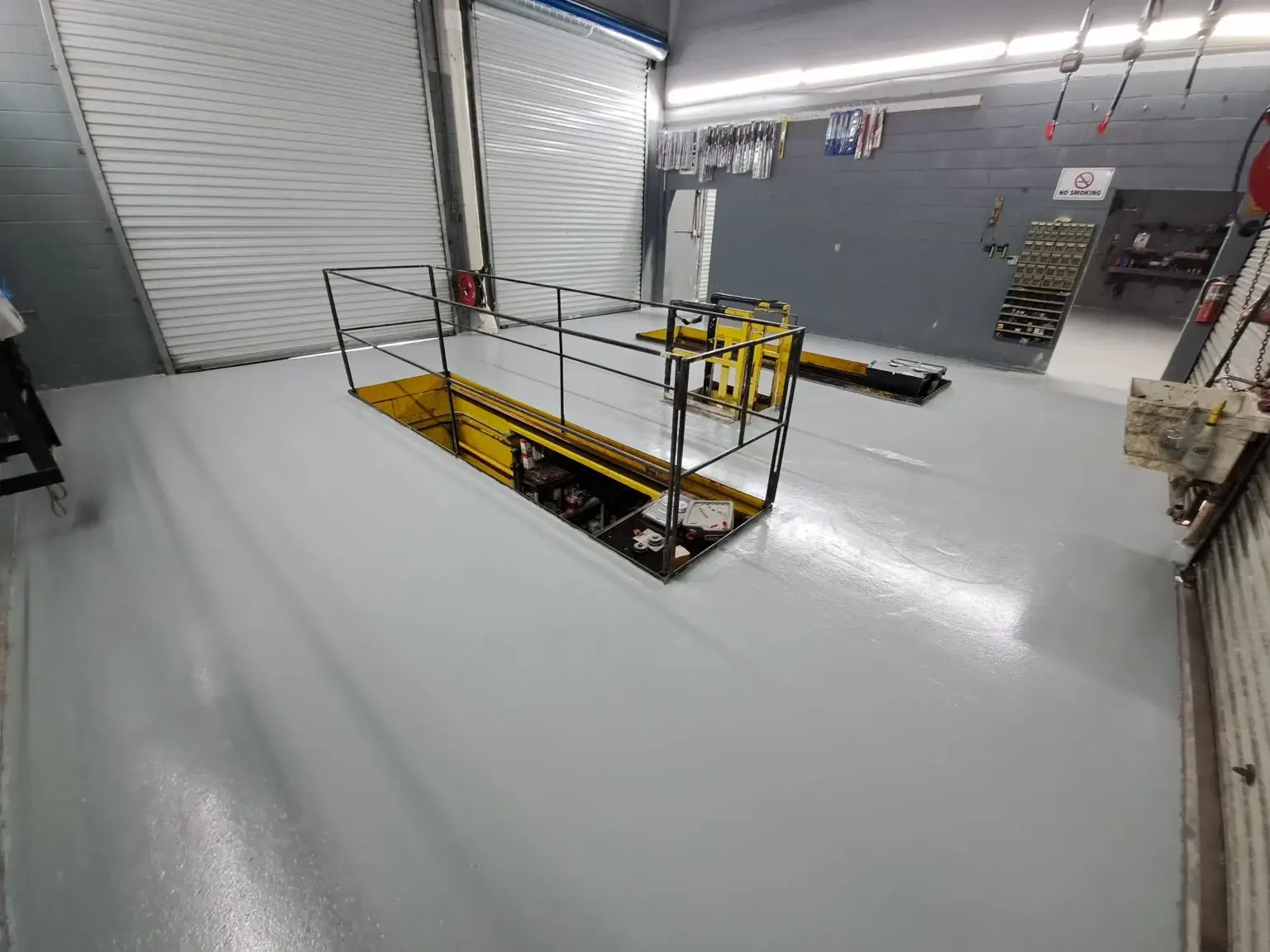
A service bay is the hardest floor most businesses own. Oil drips off every car that pulls in. Brake fluid, coolant and transmission fluid hit the floor in the middle of a job. Tires come in hot off the road, creepers roll back and forth all day, and jack stands put a corner of a truck on four small feet. Bare concrete soaks all of it up, turns dark and slick, and sheds a fine dust that settles on everything in the shop.
An auto shop floor from us is usually a solid color, often a light gray, built thick on a diamond-ground slab and finished with a tough clear topcoat. The color is the point. On a light, even floor a dropped bolt shows up from across the bay and a fresh drip tells you which car is leaking. The shop looks brighter under the same lights, and customers looking in from the waiting room notice.
This works for independent repair shops, tire and lube shops, detailing bays and the big home garages that run like a shop. If you’re tired of a floor that looks dirty an hour after it was cleaned, have Matt look at your slab. He’ll check what has soaked into the concrete before he tells you what it’ll take, and he’ll tell you plainly if the slab has a problem a coating can’t fix.
If you’re tired of a floor that looks dirty an hour after it was cleaned, have Matt look at your slab.
Lifts, drains and the spots a coating can’t fix
Around an in-ground lift, we coat right up to the lift’s frame and cover plates and leave a clean edge, so the lift can still be serviced. With two-post and four-post lifts, timing matters. If the lifts aren’t in yet, coat first and anchor them through the finished floor. If they’re already bolted down, we work around the base plates. Floor drains and trench drains get a sealed edge so water and fluids run into the drain and can’t creep under the coating.
A coating adds no strength to a slab. Lift anchors need sound concrete thick enough to hold them, and a coating won’t rescue a slab that’s cracked through or too thin for a lift. That’s a concrete question for your lift installer, and Matt will flag it if he sees it. Welding and cutting are another one: sparks and slag burn small pits into any resin floor, so a welding corner needs a blanket or bare concrete. A wash bay that stays soaked all day, or a floor that carries heavy equipment, is better served by a quartz broadcast or an industrial build.
What goes under the tires in a service bay
Degrease and grind
Oil-soaked concrete gets degreased, then diamond-ground until we reach clean concrete. Where oil has gone deep, we grind, clean and check again before anything is allowed to bond to it.
Test and repair
A moisture test, then cracks, spalls and old anchor holes filled. Edges at the drains and the lift frame get repaired so the coating has a solid edge to stop on.
Primer
A moisture vapor barrier primer where the test calls for one, or an epoxy primer worked into the fresh grind.
Solid color body coat
A thick 100% solids epoxy body coat in the shop color. This is the layer that takes the punishment from jack stands and creepers.
Bay lines
Bay outlines, walkways and keep-clear zones in front of panels and compressors, painted in before the clear goes on.
Topcoat with grip
A polyaspartic clear for hot tires and chemical resistance, with grit added in the bays where oil and coolant make the floor slick.
Open bay doors, storm water and summer tires
Most Florida shops run with the bay doors up. That lets in afternoon storms, sand off the parking lot and humid air that settles on a cool floor first thing in the morning. A coated floor sheds water toward the drains and doesn’t hold the grit, and the textured topcoat keeps footing when a wet tire tracks across it. Cars pulling in on an August afternoon come in with tires hot enough to lift a cheap coating, which is why the topcoat matters as much as the color.
Many older shop buildings sit on slabs poured without a vapor barrier, and the bay nearest the door is often the one that takes water in a bad storm. On a big slab we test more than one spot, because moisture can change from one bay to the next. Near the coast, salt air rusts everything faster, and a sealed floor at least keeps rust-stained runoff from setting into the concrete.
A coated floor sheds water toward the drains and doesn’t hold the grit, and the textured topcoat keeps footing when a wet tire tracks across it.
Squeegee, scrubber and a fresh clear coat
End the day with absorbent on any fresh spill and a squeegee toward the drain. Oil and coolant do little to a cured topcoat, but they make any floor slick, and a shop that cleans up at closing has fewer slips the next morning. An auto scrubber or a deck brush with a shop degreaser handles the weekly clean, and a hose rinse keeps degreaser from drying on the surface. Neutralize and wipe up battery acid right away.
Over the years the clear coat wears first at the bay entries and along the creeper paths. When it dulls there, we scuff it and lay down fresh clear, and the solid color underneath stays put. Matt goes over care at the walkthrough, along with the habits that make a shop floor last, like never dragging a transmission jack across it on its edge.
Want to see finished floors before you decide? See all of Matt’s floors.
Next to auto shop epoxy on the list
Matt puts this down across all six counties we cover, including Sawgrass, Green Cove Springs, Bunnell and Ormond-by-the-Sea. Most jobs start with a look at the slab, then a choice between systems like these.
Retail floors, offices and showrooms where the owner needs something that looks sharp, cleans fast and takes steady foot traffic for years.
Kitchens and back of house see hot water, grease and a scrub every night, and owners pick this so the floor still looks clean after a Saturday rush.
Heavy builds for warehouses and plants running carts, pallet jacks and chemicals over the same slab, specified by people who count every hour of downtime.
When the floor sees boiling water, thermal shock or standing wet all shift, urethane cement is the system that stays put.
Questions people ask about auto shop epoxy
Why a solid color instead of flake in a shop?
Flake is good at hiding dirt, and in a shop you want the floor to show it. A solid light color shows the drip, the lost socket and the washer that rolled under the bench. It’s also easier to keep clean around lifts and drains. Some shops add a flake border or a second color for the walkways, which keeps the bays bright and gives customers something to look at.
Will brake fluid or transmission fluid eat the coating?
Brake fluid is the one to watch. It can soften or stain many floor coatings if it sits, so wipe it up the moment it hits the floor. Transmission fluid, oil and coolant mostly make the floor slippery and do little to a cured topcoat if they’re cleaned up the same day. Matt will go over the topcoat choice for the fluids your shop handles most.
Do jack stands and floor jacks damage the floor?
A floor jack on steel wheels and a jack stand under a truck put a lot of weight on a small spot. A thick body coat over a properly ground slab handles normal shop use. The damage comes from a stand dropped hard or a jack dragged sideways. Steel or rubber plates under the stands spread the load and add years to the floor.
The coating in our bays is peeling. What went wrong?
Most of the time the slab was never ground. A coating rolled over etched or just-washed concrete has a weak hold, and hot tires and oil break it loose a little more each week. Moisture coming up from below can do it too. Either way, the loose coating comes up and the slab gets ground clean. Matt will look at where it failed and tell you why.
Can you coat a home garage that’s set up like a shop?
Yes, and we treat it like a shop. A garage with a lift, a welder and a project car on stands needs a different floor from one that holds the family car. We’d usually build the solid-color shop floor with grip in the work area and keep the welding corner covered or bare. Matt will look at how you use the space before deciding anything.
When can a car go back on a freshly coated bay?
Later than you can walk on it. Foot traffic comes back first, but a loaded vehicle, a floor jack and a set of jack stands need the coating fully hard, and that depends on the products and the weather that week. In a busy shop we can coat bays in groups so the rest keep working. Matt tells you when each bay can go back into service.
Show Matt your floor
Tell Matt what the room has to handle. He will come out, test the slab and tell you straight whether auto shop epoxy is the right call.
Want to see more first? See all of Matt’s floors.