
World Golf Village, FL, in St. Johns County
World Golf Village garages, all three bays of them
West of I-95 off SR-16, the homes are built around fairways and the garages are big. Here is how we’d treat a slab that holds two cars, maybe a golf cart and everything else.
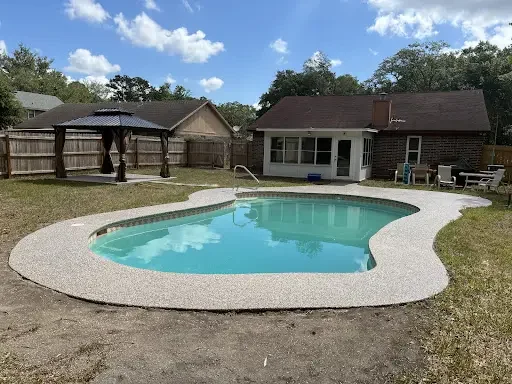
Fairway neighborhoods on the far side of I-95
World Golf Village sits west of I-95 at SR-16, and its neighborhoods were laid out around golf courses starting in the late 1990s. That puts it a long way from our beach work. There’s no sand blowing off the dunes here and no salt spray coating the porch. The slabs out here deal with heat and humidity, and with a lot of daily family traffic.
A garage door that faces west takes the afternoon sun straight onto the slab. Cars pull in hot after a run on I-95, and on a cheap garage kit those warm tires can grab the coating and peel it right up. That’s hot-tire pickup, and it’s one of the usual ways a bargain garage floor fails in Florida.
Then there’s what’s under the slab. Sandy soil and a high water table send moisture vapor up through concrete all year, and summer storms soak the driveway right up to the garage door. Matt tests the slab before he picks a primer. The first homes here went up in the late 1990s, so on the older streets he’ll also be looking for settled cracks, tire marks and oil stains that need to be ground out.
Three-car garages and the lanai out back
The typical house here has a three-car garage, and people rarely use all three bays the same way. Two hold cars. The third turns into a workshop, a home gym, holiday storage or the spot where a golf cart charges overnight. One system across the whole garage keeps it looking like one room, and scoring or a logo can mark off a work area without breaking up the floor.
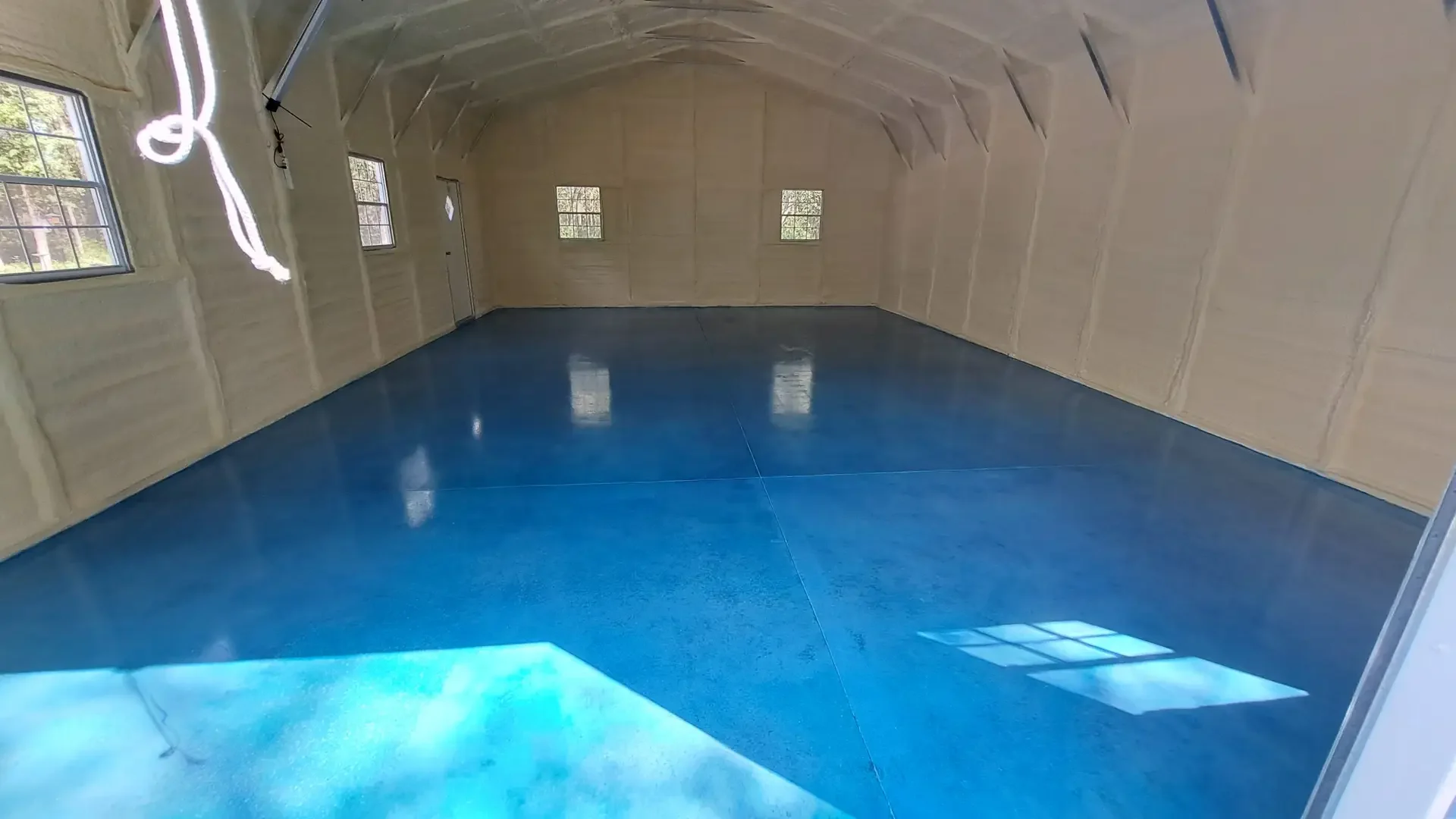
Out back, golf-course lots usually come with a screened lanai, and that slab collects pollen, leaf litter, wet shoes off the course and the odd spilled drink. Inside, some owners on the older streets are pulling up worn carpet and asking whether the slab underneath could be the floor. Often it can, once it’s ground and tested.
The typical house here has a three-car garage, and people rarely use all three bays the same way.
What we’d suggest for a World Golf Village home
What Matt reaches for most on World Golf Village slabs, and why. See all of Matt’s floors.
With three bays and hot tires coming in off the road, the garage needs a build that won’t lift when a warm tire sits on it, ground and primed properly from the bare slab up.
A full flake broadcast covers a lot of floor without looking flat, and it hides the dust and pollen that blow in every time the door opens.
A screened lanai facing the course gets sun, pollen and storm runoff. A coated patio sweeps out clean and gives you grip when the floor is wet.
For a bonus room or a slab under old carpet, a solid color or decorative epoxy turns plain concrete into a floor that’s easy to keep clean.
How a slab check works on your side of I-95
World Golf Village is close to home, straight out SR-16 from St. Augustine. Matt starts in the garage because it’s usually the biggest slab and the one that takes the most abuse. He looks at every bay, tests for moisture, checks cracks, control joints and the edge where the slab meets the driveway, and asks what each bay is really used for.
Then he tells you which system fits each space and how long the job runs. Many garage jobs finish in one day, though a big floor, or adding the lanai, can stretch the schedule, and you’ll know that before anything is booked. Have Matt look at your slab, or call Matt at (904) 671-3930.
Or email spartancoatingsfl@gmail.com with the town and a photo of the floor.
Matt answers this phone himself
Based in St. Augustine, FL, working in World Golf Village.
Finished floors first? See all of Matt’s floors.
Other St. Johns County towns on our route
Most homes here are older single-story block houses on slab along the Matanzas, which makes the garage and back porch the usual candidates for a new floor.
This stretch of Anastasia Island carries Frank Butler’s name, from the days his beach was the one African American beach in the area, and its slabs get the same salt and blowing sand as the rest of the island.
Long known for potatoes, Hastings has barns, workshops and equipment sheds whose slabs carry tractors and dirt instead of a family car.
Older waterfront homes and newer builds share the Intracoastal here, so one driveway might be a tired, chalky slab and the next a fresh pour.
Over the Vilano bridge on A1A, houses sit on a thin strip between the Tolomato River and the Atlantic, and sand works its way into every garage.
Built along the Matanzas from the 1970s on and home to many retirees, the Shores is full of garage floors that should clean with a hose and patios that should not get slick.
Everything in the county: St. Johns County.
Questions from World Golf Village
Can you do all three bays and the lanai in the same visit?
Often, if the slabs are in good shape and the systems are similar. A big garage plus a patio is a long stretch of grinding and coating, though, and sometimes it makes more sense to split it. Matt looks at the square footage and the prep each slab needs, then gives you a schedule he can keep, including when you can park again.
We charge a golf cart in the garage. Is that a problem for a coated floor?
A golf cart is light work for a coated floor. The thing to watch is the charging spot. Keep battery fluid and any spilled water off the coating and wipe drips up when you see them. If you like, a scored line or a different color can give the cart its own marked bay, so it reads as part of the design.
Can you put a logo or a team design in the garage floor?
Yes. Logo work and scoring are part of what we do, and a three-car garage has room for it. Bring Matt a clean image of the logo and show him where it should sit, ideally away from where tires roll every day. He’ll tell you how it fits into the system you picked and what it adds to the schedule.
Our house is from the late 1990s. Does an older slab need anything a newer one doesn’t?
Mostly more grinding. An older slab has had years to collect oil, paint drips, tire marks and whatever sealer a past owner rolled on, and all of it comes off before anything new goes down. Older slabs also tend to have a few more cracks along the control joints. None of that rules a floor out. It just goes into the prep.
How do we keep pollen and grass clippings from building up on a coated floor?
Blow or sweep it out regularly and hose it down now and then. Pollen and clippings wipe off a coated surface, where on bare concrete they get ground in and stain. A flake floor hides the in-between days well. Skip harsh cleaners, since mild soap and water does the job, and Matt goes over the rest at the final walkthrough.