
Spartan Coatings, St. Augustine, FL
Most of the peeling garage floors we get called to around St. Augustine failed for the same handful of reasons. Almost none of them had anything to do with the color or the label on the can.
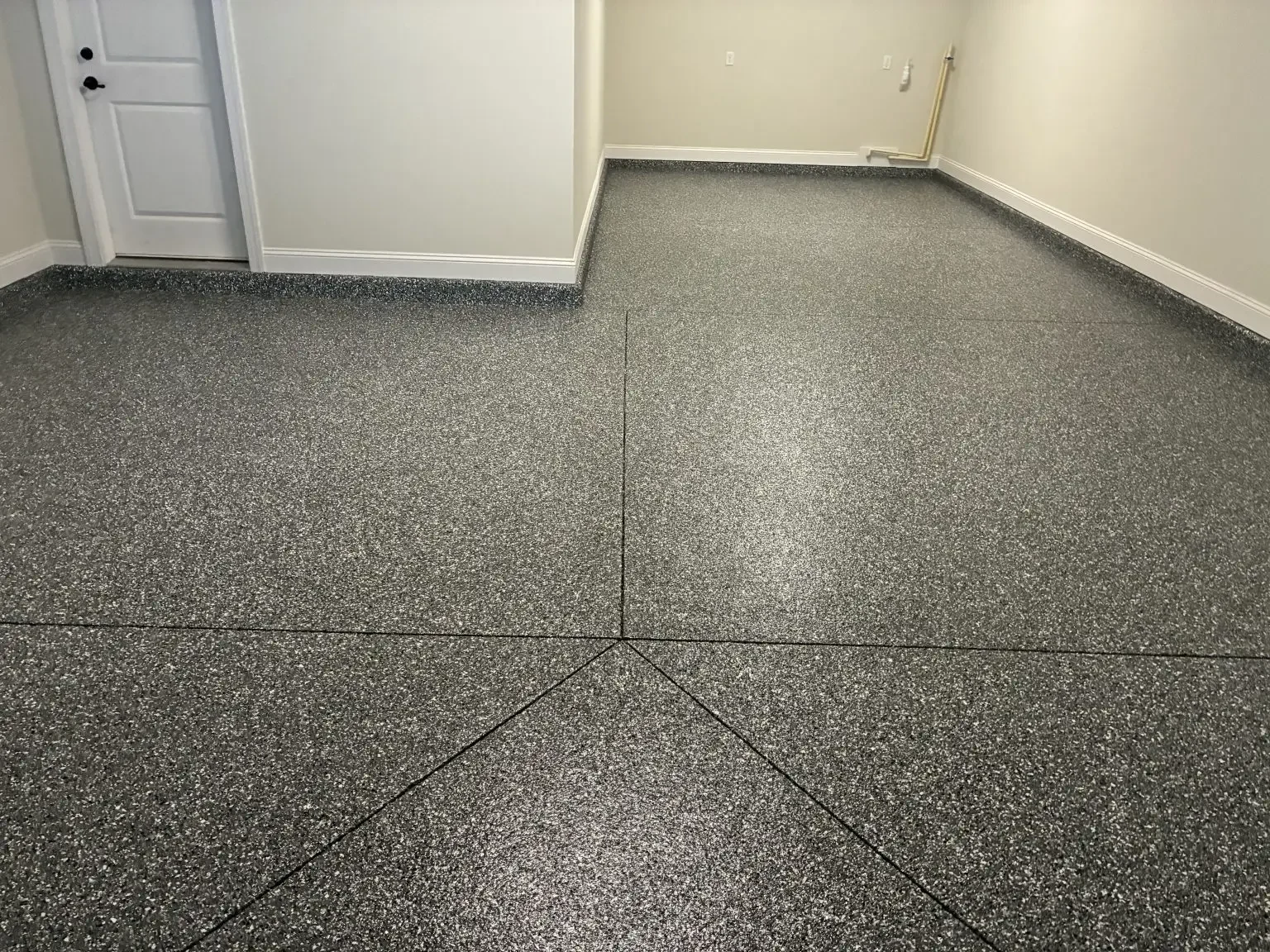
The slab is wetter than it looks
A garage slab in Northeast Florida sits on sandy soil, often over a high water table, and a lot of older homes were poured with no plastic sheet under the concrete. That slab is never fully dry. Moisture moves up through it as vapor all day long, even when the surface feels bone dry under your hand.
Bare concrete lets that vapor breathe out and you never notice it. Put a sealed film on top and the vapor has nowhere to go. It collects under the coating, pushes, and eventually lifts it. That is the white blistering you see near the back wall or along the edges, and the sheets that come up in your hand when you pick at a bubble.
New construction has its own version of this. A fresh slab is still giving off water as it cures, and a coating put down too soon traps it. If you just closed on a new house, the garage may need to wait a while before anybody coats it.
This is why Matt tests every slab for moisture before anything gets mixed. If the reading is high, the floor gets a moisture vapor barrier primer first. If it’s normal, we skip that step and tell you so. Either way you find out before the job starts, not two summers later.
Acid etching leaves nothing to grab
Most do-it-yourself kits, and plenty of quick installers, prep a garage with acid. You pour it on, it fizzes, you rinse it off, and the slab looks clean. The trouble is what it leaves behind: a surface that is barely opened up, often with residue still sitting in the pores, and nowhere near the texture a coating needs to bite into.
An acid wash only looks like prep. A diamond grinder actually opens the concrete. A diamond grinder takes off the top skin of the slab, the weak cream layer the finisher troweled up when it was poured, and leaves open, sound concrete you can feel with your palm. It also takes off old paint, old sealer, oil-soaked spots and anything else that would sit between the coating and the concrete.
You can see the difference for yourself. Turn over a chip of peeled coating from an etched floor. The back is smooth, or dusted with fine gray powder. That powder is the slab’s old surface, and it’s what the coating was really stuck to. A coating is only as strong as what’s under it.
Grinding also tells us things acid never would. Hollow spots, soft concrete and old patches show up under the grinder, and they get dealt with before the base coat goes down instead of surfacing a year later.
Thin one-part kits and what they really are
The kits on the big-box shelf are mostly one-part products, or very thin two-part ones, closer to floor paint than to a real coating. They go down at a fraction of the thickness of a full system. They look great the first week. Then the car comes in, the garage heats up, and the weak spots show.
A full system is built in layers. A base coat soaks into the ground concrete, a broadcast of flake or a solid color build goes over it, and a polyaspartic topcoat takes the abuse. Each layer has a job. Thin one out or skip it and the next one has nothing solid underneath.
Thickness matters here more than people expect. A thin film has no body to ride out a slab that moves with the heat, the sand that gets ground in under work boots, or the fluids that drip off a car. A built-up floor has enough material that a scratch stays a scratch and doesn’t open into a bare spot.
Nobody should feel bad about trying a kit. A lot of the floors we strip were first done on a Saturday by the homeowner. It just helps to know what you bought.
Then the tires come home hot
Park after a summer drive on I-95 and your tires are hot and soft. On a weak coating they grab the surface while they cool, and when you back out the next morning, the coating leaves with them. That’s hot tire pickup, and it usually shows up as four bare patches right where the car sits.
It’s more a symptom than a cause. Tires only pull up a coating that was barely holding on in the first place: paint on a slab that was never ground, or a thin kit over a slab pushing vapor. A full system bonded to ground concrete, with a polyaspartic top, doesn’t let go like that.
The garage itself adds to it. A closed garage in July gets hot enough that a soft coating stays soft all afternoon, and the strip of floor by the door takes direct sun when the door is up. Polyaspartic topcoats hold up to heat and UV, which is a big part of why we use them. There’s a separate post on hot tire pickup if your floor is already doing it.
The cracks somebody coated right over
Every slab cracks somewhere. Control joints crack on purpose, settlement cracks show up on their own, and corners and edges break off into spalls, especially at the garage door where storm water sits after an afternoon downpour. Coat over all of that without fixing it and the coating cracks along the same lines. Water gets in at the crack, and the edge starts to lift.
We repair cracks and spalls after grinding and before the base coat goes down. Saw-cut joints get filled and sealed so dirt and water stay out of them. It’s slow work that nobody notices in the finished floor, which is exactly why it gets skipped.
Old patches count too. If someone patched the slab years ago with something that’s now loose or powdery, it has to come out. Coating over a bad patch just hands the failure a head start. Same goes for an old coating that’s still stuck in some places and loose in others: the whole thing comes off, because the new floor can only be as good as the weakest square foot under it.
What the floors that stay down have in common
None of this is a secret. It takes time and the right equipment, and it’s the part of the job that separates a floor you forget about from one you’re scraping up a few summers later.
When you talk to anyone about coating your garage, ask how they prep it and whether they test for moisture. If the answer is acid, or a shrug, you already know how the floor is likely to end. A straight answer about grinding, repairs and the layers going down is worth more than any color chart.
- A moisture test before anything is opened
- Diamond grinding down to sound concrete
- Cracks, spalls and joints repaired first
- A full system built in layers, never one thin coat
- A polyaspartic topcoat that handles heat and UV
A floor that peeled once can be fixed. The old coating comes off with the grinder, the slab gets tested and repaired like any other, and the new system goes down on clean concrete. Many garage jobs still finish in one day this way, with the cure time for parking covered at the walkthrough. If your floor is already blistering or lifting, start by finding out why, because a new coat over the same problem fails the same way. Call Matt at (904) 671-3930.