
Spartan Coatings, St. Augustine, FL
A screened lanai is half house and half yard. The floor gets treated like a living room and weathered like a patio, so the right finish has to handle both. These are the options we put down, and where each one fits.
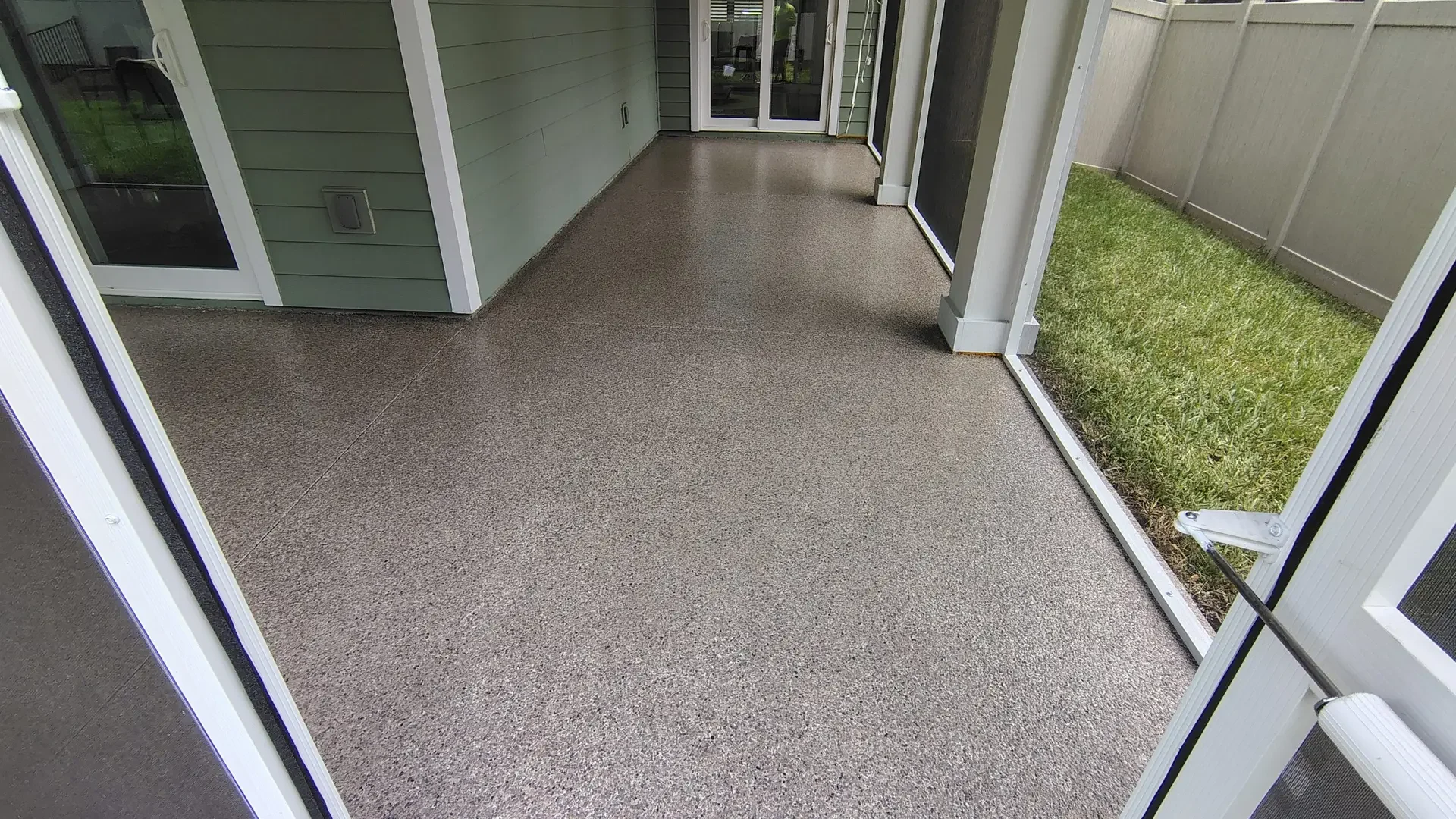
What still gets through the screen
People expect the screen to protect the floor more than it does. It keeps out the bugs and most of the leaves. It cuts the glare a bit. Plenty still gets in.
Sun comes through the mesh all day, and the strip of floor along the open side of the lanai takes it hard every afternoon. Rain comes in sideways when a summer storm blows through, and a lanai that faces the weather can have water sheeting across it for a few minutes before it drains off the edge. Pollen sifts through the screen every spring and settles in a yellow film on everything. Under live oaks, wet leaves pile up on the roof panels and drip tannin-brown water onto the floor below.
A bare slab soaks all of it in. That’s why so many older lanais have a dark stain line where the rain reaches, a gray patch where the grill sits, and brown rings under the plant pots. Any of the finishes below seals that surface so the mess stays on top and rinses off.
Flake, the one most people pick
A full flake broadcast is the most common floor we put on a screened lanai, and for good reason. The colored chips break up the surface so pollen, dust, a few tannin spots and a wet footprint don’t jump out at you. It has a little texture of its own, so it’s comfortable to walk on barefoot coming in from the pool. And it holds up to chairs being dragged around better than almost anything else.
Blend matters more out here than in a garage. A lanai floor reads as part of the house, so most people pull the colors from the stucco, the trim or the inside flooring that runs up to the slider. Lighter blends stay cooler where the sun hits and hide pollen best. Darker blends look rich in the shade but show the yellow film fast in spring.
On a lanai that opens onto a pool deck, running the same flake straight through ties the two spaces together. On one that sits off the kitchen by itself, a blend that matches the inside floors makes the room feel bigger.
Solid color, or stain and seal
A solid color floor gives a lanai a clean, modern look, and a light solid stays cool and bright. The tradeoff is that solid colors show everything. Pollen season will have you rinsing it more often, and a grill drip shows up right away. If you like a crisp look and don’t mind a hose, it’s a sharp floor.
Stain and seal is the option for people who like concrete and want it to look better. The stain soaks into the slab and gives it color that varies a little across the surface, the way stone does. A clear sealer goes over the top to bring out the color and keep water and dirt out. It looks natural and it doesn’t hide the concrete, so cracks and old repairs stay part of the look.
Stain and seal also asks for the most upkeep of the three. The sealer wears with sun and traffic and needs a fresh coat down the road, just like stamped concrete does. Flake and solid systems finish with a polyaspartic topcoat that’s far tougher, so they go much longer before they need any attention.
If the lanai is already stamped
A lot of lanais around here were poured as stamped concrete years ago. If the pattern is still in good shape and you like it, you don’t need a new floor. You need a reseal.
Stamped concrete that has gone dull, gray or cloudy is usually showing a sealer that has worn out or failed. The slab under it is often fine. Cleaned up, with the old sealer handled properly and a compatible product put back down thin, the color comes back. On a covered lanai that reseal tends to last a good while, since the roof keeps most of the rain and the hardest sun off it.
If the stamped surface is cracked across the pattern, chipped badly, or you’re simply tired of it, then it’s a candidate for a coating. Flake goes down well over stamped concrete once the high spots are ground and the low spots are filled so the new floor comes out even. Matt will tell you honestly which way he’d go on yours.
Grills, outdoor kitchens and furniture
An outdoor kitchen changes the floor plan. Grease spatters and drips, marinade gets spilled, and the area right in front of the grill gets more traffic than the rest of the lanai combined. On a sealed floor that’s a wipe-up job. On bare or worn concrete it’s a permanent dark shadow.
If an outdoor kitchen is going in, or the island is already there, plan the floor around it. Coating before a new island is built gives you one continuous surface under everything. With an existing island, we work right up to the base and seal the edge so water doesn’t get under it. Keep a mat in front of the grill if you cook a lot, and lift it to rinse underneath now and then.
Furniture is the other daily wear. Aluminum and wrought iron chairs get dragged across the floor every evening, and the bare metal feet scratch and leave rust marks. Rubber or felt glides fix most of that. Heavy planters belong on a stand with feet, never flat on the floor, where they hold water and leave rings.
- Glides on every metal chair and table leg
- Planters up on feet so water drains away
- A washable mat in front of the grill
- A rinse after pollen season and after storms
Rain lines, slope and the edge of the slab
Before any finish goes down, Matt checks which way the lanai drains. Most are poured to shed water away from the house toward the screen, and the coating has to keep that slope. If water sits in a low spot today, it’ll sit there on a new floor too, and that’s worth fixing first.
The outside edge of the slab, under the screen frame, is where rain and sprinkler spray hit the most, and where older finishes always fail first. That edge gets ground, repaired and coated with the same care as the middle, so the floor doesn’t start peeling from the outside in.
Where the lanai meets the sliding door
The few inches of floor in front of the slider get more attention from us than people expect. It’s the spot everyone steps on twice a trip, it’s where wet feet come in from the pool, and it’s where storm water tries hardest to reach the house. A coating adds a little height to the slab, so Matt checks the gap under the door track before anything goes down. The finished floor has to stay below the track, keep its slope away from the house, and leave the weep holes in the door frame clear so water can still get out.
That threshold is also where the inside and outside floors meet your eye at the same time. If the living room has gray tile or wood-look plank, a flake blend or solid color that sits well next to it makes the lanai feel like another room of the house. We mask the track and the door frame, run the coating tight to the edge, and finish that line clean, because it’s the one people look down at every time they open the door.
Every lanai is a little different: the way it faces, the trees over it, whether there’s a pool beyond the screen or a grill in the corner. The right floor comes out of those details, and one walk around the space tells Matt most of them. Have Matt look at your slab.