
Spartan Coatings, St. Augustine, FL
You back out of the garage one morning and there it is: a patch of floor stuck to the tire, and bare gray concrete where it used to be. That is hot tire pickup, and it has a cause you can fix.
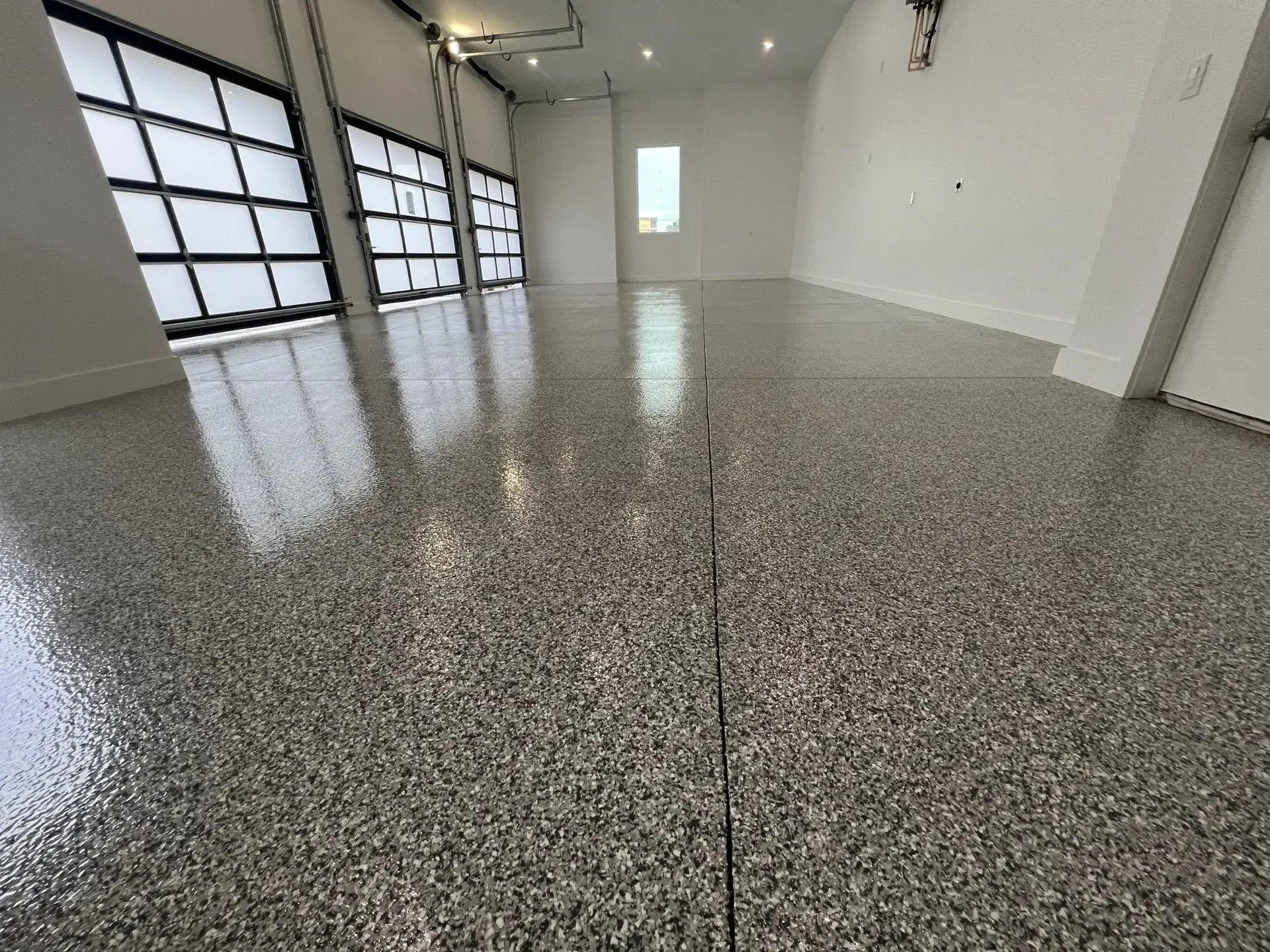
Four bare patches where the car parks
Hot tire pickup almost always starts in the same spots. It shows up under the tires, usually the rear ones first, as a scuffed or wrinkled patch that turns into a bare one. Sometimes the coating peels clean in a sheet. Sometimes it leaves a perfect tread print in the film before it lets go. Either way it gets bigger every time you park.
It tends to show up in summer, and it tends to show up on floors that are fairly new. People are surprised by that. The floor looked fine through the spring, and then a few hot weeks in June or July and the tire marks start appearing. Nothing changed about the floor. The weather just found its weak spot.
Once it starts, it doesn’t stop on its own. Every edge left behind is a new place for the next hot tire to grab, and water from a wet car gets under those edges too.
Why a hot tire grabs a weak floor
A tire coming off the highway on a Florida afternoon is hot, and hot rubber is soft and a little sticky. Park it on the floor and it presses down while it cools. Overnight the rubber shrinks and tugs at whatever it’s stuck to. If the coating is soft, or barely bonded to the slab, the tire takes a piece of it along when it rolls away.
Two things have to be true for that to happen. The coating has to be soft enough to stick to warm rubber, and the bond between the coating and the concrete has to be weaker than the grip of the tire. Fix either one and the problem goes away. A good floor fixes both.
Florida stacks the deck. The tires are hotter, the garage itself is hot, and a slab pushing moisture up from below weakens the bond from underneath. On a lot of floors we see, the tire is just the last straw.
Paint and thin kits are the usual victims
Garage floor paint and the one-part kits sold next to it are the floors we see this on most. They go down thin, they stay soft in the heat, and they’re usually rolled onto concrete that was cleaned or acid etched instead of ground. That’s the worst combination for a tire to sit on.
Thin two-part kits do better, but not much. The film is still thin, and the prep that comes with a kit is still a bucket of acid and a hose. When the bond is weak, a better coating on top doesn’t save it.
Old sealers are another one. A clear sealer someone put down years ago can look fine until a car sits on it in August. If there is any old product on the slab, it has to come off before anything new goes down.
The tires matter a little too. Soft, grippy rubber that holds the road well holds a soft floor just as well. Nobody is going to change tires for the sake of the garage, though, so the floor is where the fix has to happen.
What actually stops it
The fix is the same one that keeps a garage floor from peeling for any other reason. Start with the slab, not the coating.
We diamond-grind every garage before it gets coated. Grinding takes off the weak top skin, the old paint or sealer and the oil spots, and leaves open concrete for the base coat to soak into. The base coat bonds into the concrete itself instead of sitting on top of a dusty film. The floor gets built up in layers from there, and the top layer is a polyaspartic, which stays hard in the heat and stands up to UV at the door.
- A moisture test first, and a vapor barrier primer if the slab needs one
- Diamond grinding to sound, open concrete
- Crack and spall repair before any coating
- A full build: base coat, flake or solid color, then the top
- A polyaspartic topcoat that stays hard when the tires are hot
- Full cure time before the car comes back in
Living with the floor you have until then
If your floor is already lifting, a few things will slow it down. Let the car cool for a while in the driveway on the hottest days before you pull in. A pair of parking mats under the tires keeps hot rubber off the coating entirely. They look like what they are, but they work.
Don’t pick at the loose edges, and don’t pressure-wash the floor. Both open up more edges and drive water under the coating that’s still holding. Sweep it and damp-mop it and leave it alone.
Resist the urge to roll another coat of the same kit over the bad spots. It feels like a repair and lasts about as long as the first coat did, and every layer you add is one more layer that has to come off later. Stripping a failed floor is a normal part of our work, and it goes faster when there’s only one bad coating on it instead of three.
Questions to ask before your next floor
If you’re getting the floor redone, ask whoever comes out how they prep the slab and what goes on top. Grinding and a polyaspartic top are what you want to hear. Ask how long before you can park on it, too. A coating that’s walkable in hours still needs its full cure before a hot tire sits on it, and the answer should come with a straight timeline.
Many garage jobs with us still finish in one day, prep included. Matt will tell you at the final walkthrough when it’s safe to bring the car home.
Is it really the tires, or something else?
Not every bare spot in a garage is hot tire pickup, and the fix depends on what you’re looking at. A few minutes on your knees with a flashlight will usually tell you.
Tire damage lives where the tires sit. It’s in four patches, or two along the back, often with a tread pattern pressed into the coating around the edges. The rest of the floor is usually fine. If you can slide a fingernail under the edge and lift a clean flake of coating with smooth concrete underneath, the bond was weak and the tire finished the job.
Moisture failure looks different. It shows up as bubbles or blisters, often near the back wall, along the edges, or in the middle of the floor where no car ever parks. Pop one and you may find damp concrete or white powder under it. That points to vapor coming up through the slab, and a new floor will need a moisture test and likely a vapor barrier primer.
Chemical damage is its own thing. A soft or stained spot under where the lawn mower sits or where a gas can leaked usually means something ate into the coating from the top. Worn traffic lanes, on the other hand, are dull paths from the door to the house, where grit has slowly sanded off the gloss. Neither one is a bond problem.
Plenty of floors show more than one of these at once. That’s normal on an older coating, and it’s why Matt looks at the whole slab instead of just the spots under the car. Knowing which failure you have keeps you from fixing the wrong one.
Hot tire pickup is a prep problem wearing a tire track. Grind the slab, build the floor right and top it with something that stays hard in July, and the car can sit there all summer. Have Matt look at your slab.